The Amenities That Actually Matter for Startups in 2026.
office spaces
Startups are leaner, more intentional, and far more aware of how space affects performance. Founders are no longer asking, “What looks impressive?” They’re asking, “What actually helps my team work better, stay focused, and grow without friction?” We see this shift every day. The modern workspace is no longer a showroom: it’s an operating system.
That is where the discussion about the best office amenities for startup business really commences.
What founders now expect from the best offices for their startups
In 2026, startups are not competing on excess; they are competing on clarity. Communities are looking for environments that make their lives easier, not harder. Reliable and enterprise-grade-quality networking is now non-negotiable. It’s not just about having robust and quick Internet anymore; it’s also about delivering that Internet during critical times of operation and when working with others all around the globe. When the Internet and networking are out of commission, productivity is broken and fragmented.
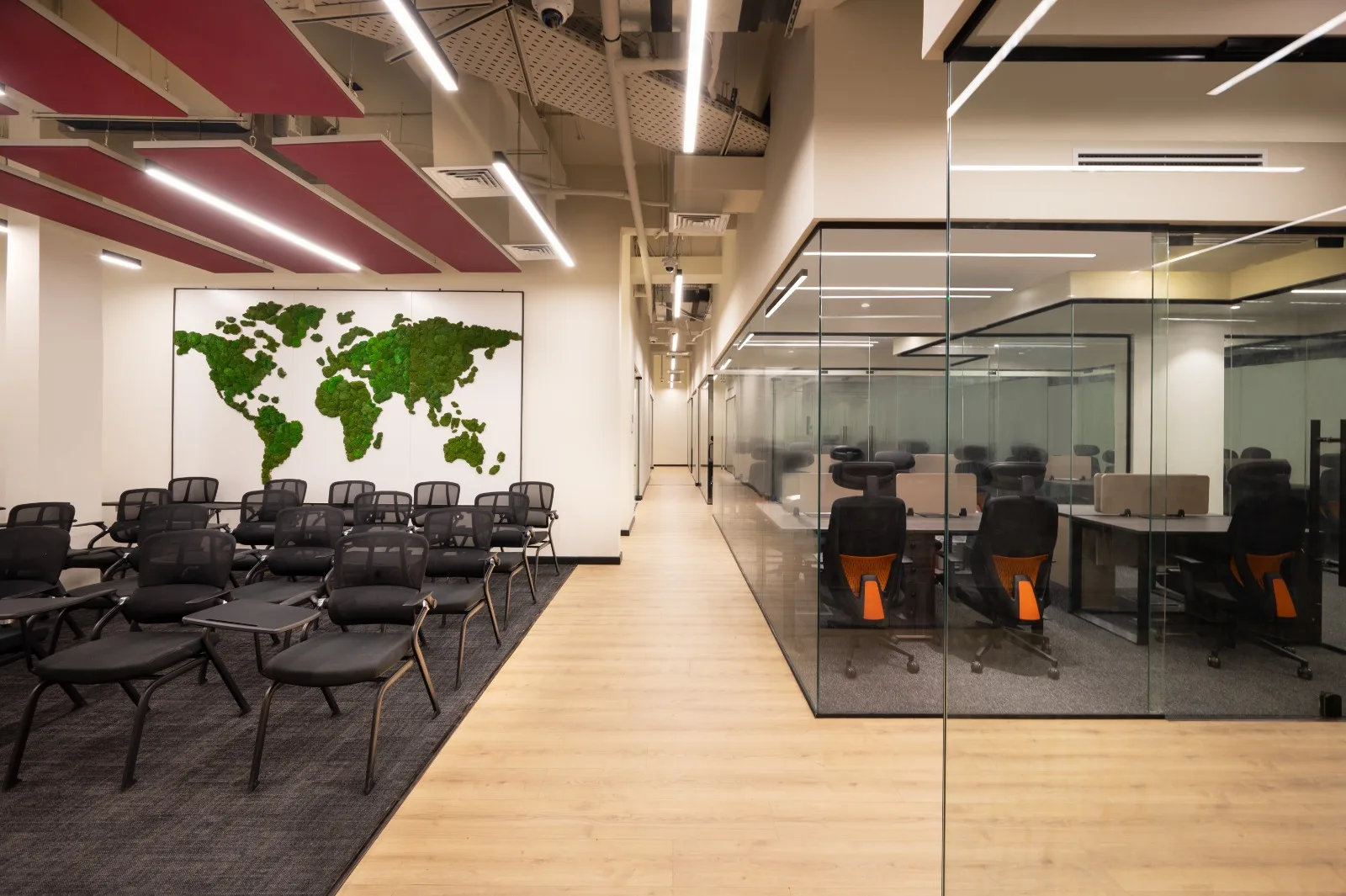
Sound management is yet another silent priority. While open-plan designs were the epitome of style just ten years ago, today’s workforce needs the depth of full isolation coupled with the strength of full interaction. Successful offices create the perfect balance of sound through creativity in planning full isolation chambers. But let’s be clear: this is not about quiet. It is about control.
Even the facilities and spaces where meetings take place have become somewhat managed. Startups don’t need many meeting rooms. They just need the most suitable ones. Meeting spaces that can support hybrid meetings, pitches, and internal meetings without technical or booking issues. Successful meetings result in speedy decision-making processes.
Even something as basic as lighting, air quality, or ergonomic design has shifted from “nice to have” to “must have.” This recognition stems from the founders’ desire to understand that burnout is not an inherent result of workload and responsibilities. It arises from an environment that leaches away productivity every day.
The Impact of Future Office Facilities on Daily Work
What we’re really talking about when we talk about what’s coming in terms of office amenities is what’s happening on a human level in terms of how work is becoming more than a team of people simply coming in to sit in a chair at a desk. What’s coming are offices to facilitate moments that matter to us. Thinking, deciding, working together, and of course, unplugging to recharge from all that’s happened in a day of work.
Being flexible has become essential. Startups are growing in every possible way faster compared to established organizations. Space amenities that encourage flexibility to adapt quickly to growth and changes are much more important compared to luxurious and impressive designs.
Another change involves technology itself. We no longer think of it as a feature to consider in a conference center. We think of it as a backdrop to work. Smart access control technologies, straightforward room management solutions, and collaborative working have a clear goal: to completely integrate these concepts into the background of work processes in such a way that no staff member consciously realizes what’s available to support them to achieve their aims.
Wellness has also grown up. In 2026, perks like access to natural light, quiet areas, and well-thought-out shared public spaces actually help people manage energy throughout the day. Startups have realized that being more productive isn’t about being better at the task at hand; it’s about maintaining the energy to keep pushing forward. Location-based facilities will also continue to gain more significance. Facilities like proximity to public transportation, dining options, and service professionals make daily life easier. If the workplace is embedded in the rest of daily life, people will be more engaged.
What really makes up next-gen office amenities today
“Next-gen” has been bandied about quite a lot in the context of future office amenities. The reality is that the phrase has very little real meaning in this context. What does “next-gen” actually mean from our point of view? It has very little to do with the word “futuristic.”
New next-gen office amenities respect personal time. They reduce waiting times, troubleshooting issues, and minimize movement around any environment. They speedily guide personnel in shifting between different tasks without requiring them to reset their environment every hour or so. They also respect autonomy. Teams want spaces that let them choose how to work on a given day. Whether that’s a quiet corner for focused execution or an open area for creative discussion, the best amenities offer options without overwhelming choice.
Of course, this also contributes to security and reliability. With startups handling sensitive data and global clients earlier in their life cycle, secure access, controlled entry points, and reliable systems become imperative. Trust is conveyed not just by people, but by environments that appear stable and professional. Most importantly, next-gen amenities align with outcomes. They don’t exist to impress visitors; they exist to help teams move faster, think more clearly, and collaborate better.
Why Workspace Downtown understands this shift
At Workspace Downtown, we never design spaces based on a trend alone. We design based on observation. The years of working closely with startups have shown us what gets used daily and what quietly gathers dust. We pay attention to how teams move through their day: where they pause, get stuck, or where friction shows up. That insight shapes every decision we make-from layout planning to amenity selection.
This cross-industry experience has given us a wider lens. We see how early-stage teams grow into structured organizations and how their needs evolve along the way. That perspective lets us design environments that support growth without requiring constant relocation or redesign. We don’t think in terms of “loading up a space with lots of features”. We think in terms of “getting the right features, implemented correctly, and serviced correctly”. Consistency may be as important as creative freedom; in some contexts, that’s a given
Why This Model Is Applicable to a New Team
Startups thrive when attention is on the business and not on the building. Our approach works because we focus on removing distraction and not on adding spectacle. So if the amenity itself is easy to understand, the team can settle in much faster. If the infrastructure itself is robust, the leaders don’t have to constantly fight issues. If the space adjusts itself so that the growth feels controllable rather than unmanageably chaotic.
Clients choose Workspace Downtown because we act as partners, not landlords. We understand that office space is a strategic tool. When aligned correctly, it supports culture, performance, and credibility all at once. We design for the long game. Not just the first impression, but the thousandth workday.
The office in 2026 isn’t disappearing. It’s becoming more honest. Amenities are no longer about showing what a company can afford. They’re about showing how seriously it takes its people and its work. The future belongs to workspaces that understand this balance. Spaces that feel effortless, grounded, and quietly effective. At Workspace Downtown, that’s the future we’re building toward, one thoughtful decision at a time.